The MarginSurge Guide to Restaurant Food Distributors: Minimums, Terms, and Who Will Take a New Account
Your broadline distributor is the single largest check an independent restaurant writes every month, and unlike rent or payroll, almost none of what you pay is posted anywhere you can read it.
We put the four national broadline distributors that independent and startup restaurants actually get pitched by through a side-by-side review: Sysco, US Foods, Performance Foodservice, and Gordon Food Service. Here’s how they compare on the things that matter before you have volume — who will open an account for a business that hasn’t served a plate yet, what happens when your order is small, and how much of the deal you can see before you sign it.
Who Will Actually Deliver to a Brand-New Restaurant? We Compared the 4 Major Broadline Distributors
A MarginSurge Buyer’s Guide
We evaluated each distributor specifically through the lens of an independent or startup restaurant — one location, limited storage, no purchasing department, and not enough weekly volume yet to be anybody’s priority account. That is a very different buyer from the multi-unit group these companies build their national programs around, and the difference shows up immediately in three places: whether they’ll take you at all, what they charge you when your order is small, and how much of the pricing you get to see before you commit.
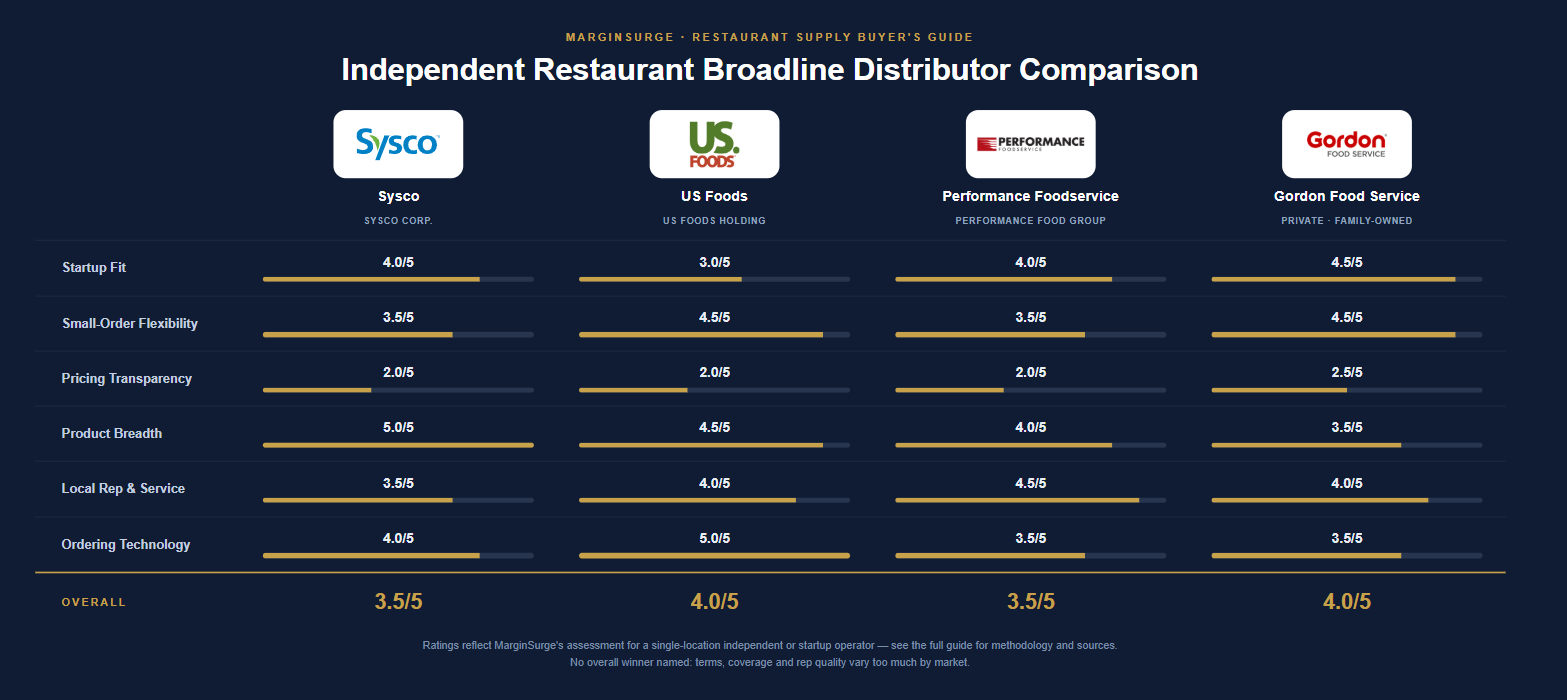
A note on how we rated these — and why there’s no winner this time. In our POS comparison we named a top pick, because POS pricing is published, national, and roughly the same in Boise as it is in Baltimore. Distribution is the opposite. Terms are set locally: your market, your distribution center, your sales consultant, and your projected weekly spend. Two restaurants a mile apart can be quoted different markups by the same company. On top of that, one of these four may not deliver to your address at all — Gordon Food Service doesn’t run trucks on the West Coast, and US Foods’ small-order program only exists in about 70 metros. A national “best distributor” would be a fiction, so we’re not going to invent one. The scores below rate each company on how it is built for a small, new operator; the closing section tells you which one to call first given your situation.
Treat every figure here as a starting point for your own written quote, not a guarantee. None of these four publish restaurant pricing, and all four confirm in writing that a rep sets your numbers only after you open an account.
● Sysco — Sysco Corporation
MarginSurge Score: 3.5 / 5
Sysco is the largest food-away-from-home distributor in the world — more than $84 billion in sales in the fiscal year that ended June 2026, 333 distribution centers across 10 countries, roughly 670,000 customer locations. For a startup, the relevant part of that scale isn’t the catalog, it’s the front door: Sysco states that all you need to open a business account is your Tax ID or EIN, that a local representative contacts you within one to two business days, and that most approved businesses can order immediately. Of the four, it has the lowest documented barrier to becoming a customer at all. Where it gets weaker is attention and transparency — a single-location account is a rounding error inside an $84 billion company, and Sysco’s own FAQ is explicit that you cannot see pricing before you sign up.
Getting in: Tax ID / EIN is the stated requirement; a sales-tax document is recommended but not required; no residential or personal-use accounts
Small orders: “Sysco Your Way” advertises no order minimums, late cutoffs and next-day delivery — but it is a neighborhood-by-neighborhood program, so confirm your street is in it before you count on it
Catalog: 500,000+ products through Sysco Shop, plus specialty arms (FreshPoint produce, Greco & Sons Italian, Buckhead and Newport Meat)
Pickup: will-call exists at some warehouses only, and pickup-only accounts need local approval — just three retail stores nationwide, in Minnesota and Maryland
Extras: Sysco Perks (deliveries up to six days a week), menu design and business consulting, a claimed 97% on-time delivery rate
Watch this one: in March 2026 Sysco agreed to buy Jetro Holdings — the parent of Restaurant Depot — for about $29 billion, a deal that would push its revenue toward $97 billion and fold the country’s largest cash-and-carry into the country’s largest broadline distributor. It is under FTC review, and Sysco’s CEO said publicly in August that he expects it to close in early 2027. If Restaurant Depot is currently your price check on Sysco, understand that it may not be an independent price check for much longer.
● US Foods — US Foods Holding Corp.
MarginSurge Score: 4.0 / 5
US Foods is the most honest of the four about not wanting a small account — and, paradoxically, the best equipped to serve one anyway. Its own become-a-customer page states that minimum orders apply, that “weekly truckload deliveries or more are required,” and that “our service may not be the perfect fit for everyone.” Read that and stop, and you would conclude a startup has no chance. Read further and you find the two channels that make US Foods genuinely workable for a small operator: Pronto, a small-order delivery program with no minimums, six-day-a-week service and an 8 p.m. cutoff for next-day delivery; and CHEF’STORE, roughly 95 cash-and-carry warehouses open to the public with no membership, where a restaurant that hasn’t opened yet can buy at case prices today. Its digital tooling — MOXē, CHECK Business Tools, VITALS — is also the strongest in the category by a clear margin.
Getting in: a valid business license or EIN plus a commercial address; the credit application needs LLC details, resale tax number and banking information; shipping typically starts within five business days
Broadline requirement: minimum order size varies by location and weekly truckload delivery is the stated baseline — “flexible solutions may be available in certain markets”
Small orders: Pronto carries no minimums, though additional charges may apply under 10 cases; it exists in roughly 70 metro markets, so confirm yours is one of them
Cash-and-carry: CHEF’STORE operates in 14 states with no membership and no in-store minimum; $100 minimum for online CLICK&CARRY pickup; broadline account holders can charge store purchases to their account
Momentum: independent restaurant case volume grew 5.1% in the quarter ended June 2026 — independents are the segment it is actively buying
One caveat: US Foods has said since its 2024 investor day that it is exploring strategic alternatives for CHEF’STORE — corporate language for a possible sale — on the grounds that the retail business would benefit from focused investment under new ownership. The stores are still open and still branded US Foods, but if the CHEF’STORE down the street is the reason you are choosing US Foods, know that its ownership is not guaranteed to stay put.
Where it fits: strong if you are in a Pronto or CHEF’STORE market and you have tight storage or daily prep. Weakest of the four if you are rural, low-volume and outside both programs — in that case the truckload language on their own site isn’t marketing softness, it’s the actual answer.
● Performance Foodservice — Performance Food Group
MarginSurge Score: 3.5 / 5
Performance Foodservice is the one of the four whose growth story is independent restaurants. In the fiscal year that ended June 2026, its independent case volume rose 10.2%, and by the fourth quarter independents accounted for 43.1% of Foodservice segment sales — the highest independent mix in this group. It also runs the most decentralized model: rather than one national program, Performance operates through local operating companies with their own warehouses, chefs and reps, a structure deepened by buying Reinhart Foodservice in 2019 and Cheney Brothers in 2024. In practice that means the person quoting you often has real authority to make a deal, which is worth more to a small account than a slicker app. The trade-off is consistency — what you are offered in one market may not exist in the next, and there is no published small-order program to hold anyone to.
Scale: 65 distribution centers, 250,000+ products, roughly 500,000 deliveries a month, 125,000+ customers; PFG overall did $67.8 billion in fiscal 2026, with the Foodservice segment at $36.6 billion
Getting in: no published requirements or minimums — you are routed to the local operating company, and terms are set there
Exclusive brands: West Creek, Roma, Braveheart Black Angus and others, which is usually where the margin conversation starts
Ordering: CustomerFirst, its newer ordering and account platform — functional, but behind US Foods and Sysco on inventory and analytics tooling
Extras: the One Source partner program (marketing, operations and staffing vendors), a chef council and The Dish publication; note that Performance publishes a fuel surcharge notice, so ask where that lands on your invoice
Where it fits: the best odds of a genuinely local relationship and a rep who can say yes, particularly east of the Rockies and across Cheney Brothers’ Southeast footprint. Verify delivery days and any minimum in writing, because almost nothing about it is standardized nationally.
● Gordon Food Service — privately held, family-owned since 1897
MarginSurge Score: 4.0 / 5
Gordon Food Service is the smallest of the four and the only one not answerable to public shareholders — roughly $21 billion in revenue, 14 U.S. distribution centers, still family-managed 129 years in. For a startup, though, its real advantage isn’t the balance sheet, it’s the front door: more than 180 Gordon Food Service Stores, open to the public seven days a week with no membership and no annual fee. You can walk in before you have an EIN, buy by the case at prices printed on the shelf, apply your tax exemption at the register, and actually see what things cost — which is more price transparency than any other company on this list will give you before you sign. Its free Gordon GO program is explicitly built for businesses not yet receiving truck delivery, which describes every restaurant in its first month. The catch is geography: no West Coast, no Mountain West.
Coverage: GFS describes its delivery footprint as the Midwest, Northeast, Southeast and Southwest, plus coast-to-coast Canada. If you are on the West Coast or in much of the Mountain West, check the coverage map before you plan around a GFS truck — in some of those markets it serves operators through its stores rather than broadline delivery
Stores: 180+ locations open to the public with no membership; cash, check, cards, SNAP/EBT and mobile pay accepted; case quantities of proteins, dairy, produce, paper and chemicals, plus smallwares and packaging
Fill-in strategy: GFS positions the stores as fulfillment between scheduled truck deliveries, with same-day pickup or express delivery — the cleanest answer in this group for the Friday you run out of chicken
Gordon GO: a free loyalty program for business customers not on truck delivery, with store discounts, online catalog access and electronic receipts; sign-up takes about two minutes
Service model: a Customer Development Specialist as your account contact once you are on delivery
Where it fits: the strongest structural fit for a pre-opening or very-low-volume operator — if you are inside its delivery region. Narrower catalog than Sysco or US Foods, so a specialty-heavy menu may still need a second supplier.
A few practical notes that apply no matter which of the four you call. Ask whether you are being quoted cost-plus — their landed cost plus a disclosed markup — or street price, a single number with the markup buried inside it; and if it is cost-plus, get the markup by category in writing. Build a market basket of your 20 highest-volume items and re-bid that exact list every six to twelve months, because it is the only way to know whether your pricing has quietly drifted. Get the order minimum, the fee for going under it, the delivery days and window, and the fuel or delivery surcharge in writing before your first delivery, not after. Be careful with volume commitments and prime-vendor agreements in year one — a discount that requires a weekly spend you cannot yet predict is a liability, not a saving. And plan on two sources from the start: a delivery distributor plus a cash-and-carry or store, so a missed drop is an inconvenience rather than a closed dining room.
Worth knowing about the category itself: consolidation at the top is accelerating. US Foods pursued a combination with Performance Food Group in late 2025 — talks that would have created a roughly $100 billion company, called off by mutual agreement — and in March 2026 Sysco agreed to acquire Restaurant Depot’s parent for about $29 billion, a deal still under FTC review. Fewer independent price checks in a market has never once made an independent restaurant’s invoices cheaper. Whatever you sign now, keep the term short enough that you can react.
Our Take
We are not naming a winner here, because the honest answer depends on facts we do not have about your restaurant. What we can do is tell you who to call first.
If you haven’t opened yet, or your volume is tiny: start with the cash-and-carry channels rather than a sales rep. Gordon Food Service Stores and Gordon GO, or US Foods CHEF’STORE, will sell you case quantities today at posted prices with no account and no membership — and that gives you a real price baseline to hold your eventual distributor against.
If you have one walk-in, daily prep and no room to hold a truckload: ask US Foods whether Pronto serves your address, and ask Sysco whether your neighborhood is in Sysco Your Way. Those are the two named programs in this group built around small, frequent orders.
If you need the widest catalog under one invoice — specialty, produce, custom-cut protein, smallwares — Sysco is the deepest, with the caveat that a single-location account is small inside a company that size.
If what you want is a rep with actual authority and a distributor whose growth depends on operators like you, Performance Foodservice has the highest independent mix of the four and the most local decision-making.
And whichever you choose: get quoted by at least two of them on the same market basket, in the same week, before you sign anything. The spread between the first quote and the second is usually larger than anything you will save arguing over a single case price. And if you have already signed, the money is still recoverable inside the agreement you have — our guide to auditing your Sysco or US Foods contract walks the six places it leaks.
Need help reading a distributor quote, building a market basket, or renegotiating an agreement you have already signed? Book a free 20-minute consult — we will look at your real invoices, not the marketing page. Food cost is one half of the margin equation — the technology and labor half is in our Complete Guide to Restaurant Technology & Automation in 2026. We do this work hands-on for restaurants in Los Angeles and Phoenix.