The MarginSurge Guide to Restaurant Service Robots: Pricing, ROI, and Our Top Pick
Should Your Restaurant Buy a Service Robot? We Compared 6 Models So You Don’t Have To
A MarginSurge Buyer’s Guide
Labor is the line item keeping most restaurant owners up at night. According to the National Restaurant Association’s 2025 Restaurant Operations Data Abstract, salaries and wages (including benefits) ate up a median 36.5% of sales at full-service restaurants and 31.7% at limited-service restaurants in 2024 — and operators who stayed profitable ran leaner, at a median 34.2%, while unprofitable operators saw labor climb to 42.9% of sales. That gap is exactly where service robots are trying to make their case.
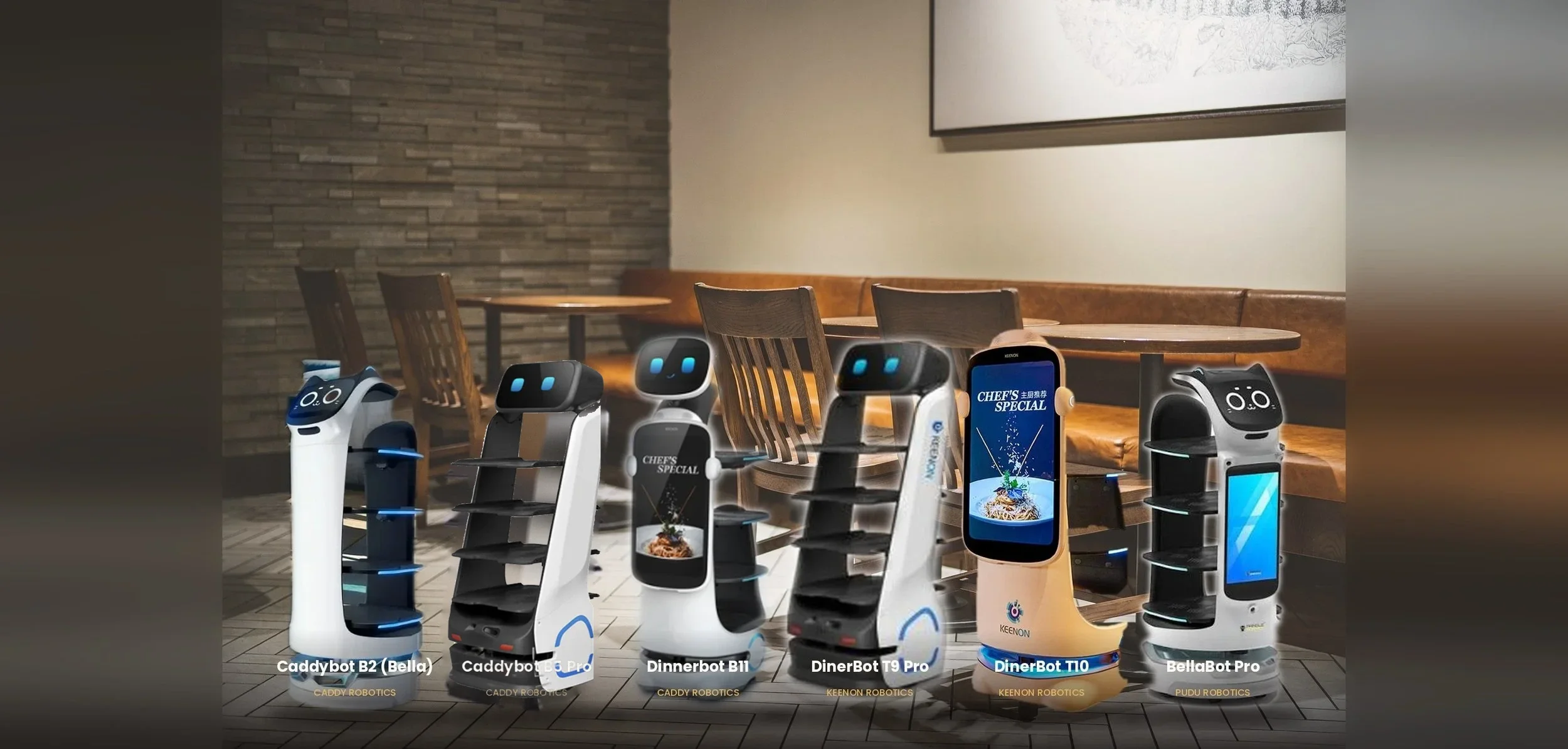
We put six of the current tray-delivery robots being pitched to restaurant owners through a side-by-side review: three from Caddy Robotics (which sells rebadged and Keenon-family hardware direct to restaurants with financing built in), two from Keenon Robotics (the category’s largest global player), and one from Pudu Robotics (the company that popularized the cat-face server robot). Below is how they stack up, what they actually cost, and which one we’d point a client toward first.
A robot is rarely the first thing we would spend on, and where it sits against everything else is laid out in our complete restaurant technology guide, alongside the systems that usually pay back faster.
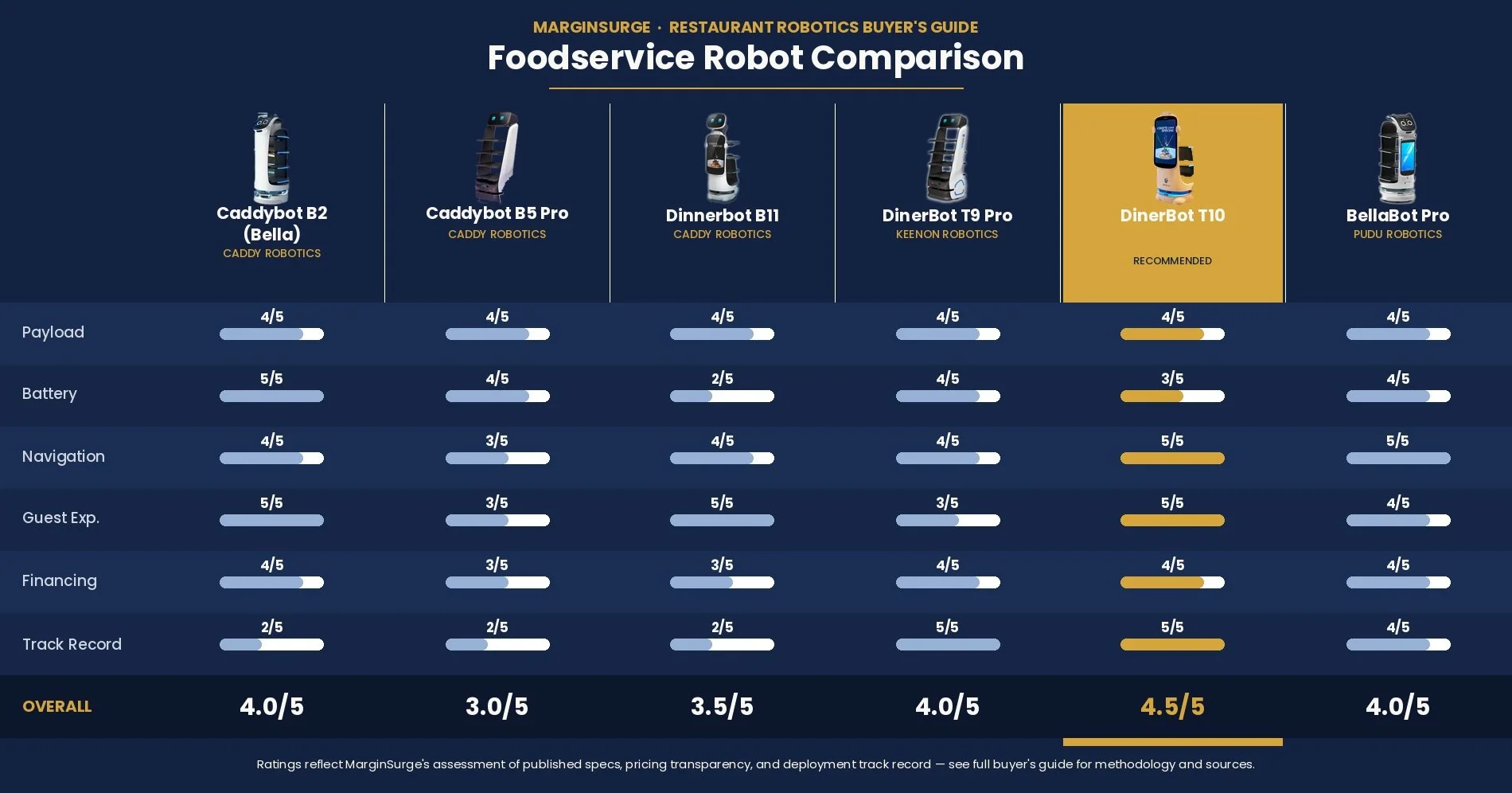
A note on how we rated these. MarginSurge has hands-on deployment experience with the Keenon and Caddy Robotics lines specifically, and that experience shapes some of the judgment calls below — particularly around financing and after-sale support, which are harder to quantify from a spec sheet alone. Where pricing is involved, we’re flagging it clearly: reseller pricing for these robots is inconsistent, sometimes by more than 50% between dealers for the same model, so treat every dollar figure here as a starting point for your own quote request, not a guarantee.
DinerBot T10 — Keenon Robotics
MarginSurge Score: 4.5 / 5 ⭐ Recommended Pick
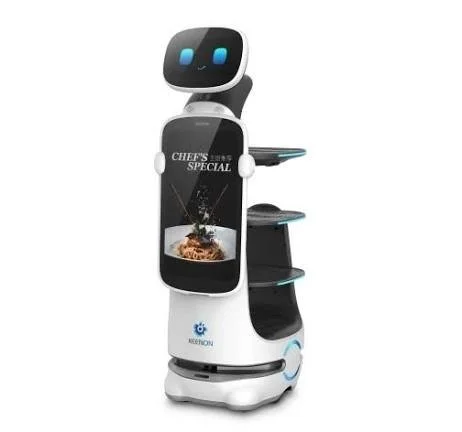
The T10 is Keenon’s current flagship, and it shows. It won the iF Design Award 2025 — selected from nearly 11,000 submissions across 66 countries — for a bio-inspired interaction design where a touch on its head accessory triggers responsive head movement and voice feedback, and its AI Tray Detection automatically advances once a guest or server clears an item. It’s in deployment across 60+ countries, including a widely cited U.S. rollout at Burger King’s “Redi” automation pilot.
Payload: 88 lbs across four adjustable trays (per Keenon marketing; independent reseller spec sheets are inconsistent on this figure, so confirm with your rep)
Battery: 6–8 hours per RobotLAB’s own spec sheet, though other marketing material claims up to 10 hours — we’d plan around the more conservative number
Screen: 23.8" display for menu specials, upsells, and order status
Navigation: LiDAR + VSLAM, mature and widely field-tested platform
Why it’s our top pick: it’s the only robot on this list with independent design-award recognition, the deployment scale to prove out reliability at real volume, and a large enough reseller network that parts, service, and financing are easy to find. It’s not the cheapest option here, but it’s the one we’d bet on for uptime.
Bellabot Pro — Pudu Robotics
MarginSurge Score: 4.0 / 5
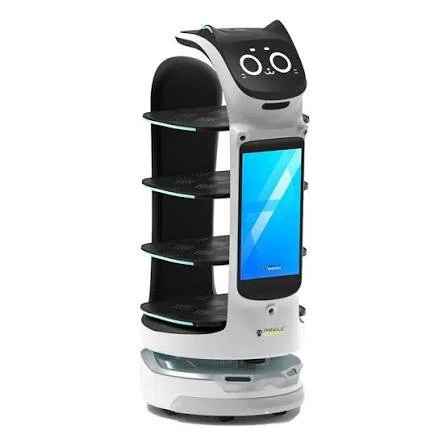
BellaBot Pro is the refined version of the robot that arguably started the cat-face-server trend, and Pudu’s own spec sheet is the most transparent of any manufacturer here. It carries real name-brand deployments — Kura Sushi USA and IHOP locations have both rolled out Pudu server robots, though we can’t confirm every one of those locations is running the Pro variant specifically rather than the standard BellaBot.
Payload: 88 lbs across four adjustable trays
Battery: 11 hours unloaded per Pudu’s official spec, 4.5-hour charge
Safety: “Omni-Sense” system — 2 forward cameras, 3 RGBD sensors, 1 radar for full front-chassis obstacle detection
Screen: dual display — 10.1" plus an 18.5" secondary screen, the largest ad/menu surface in this lineup
The catch: pricing for BellaBot Pro is genuinely murky. One reseller (RobotLAB) lists it around $16,000 purchase / $399 per month on a robot-as-a-service plan — but the same site separately prices the non-Pro BellaBot both cheaper and more expensive elsewhere on its own pages. Get a written, model-specific quote before you sign anything.
DinerBot T9 Pro — Keenon Robotics
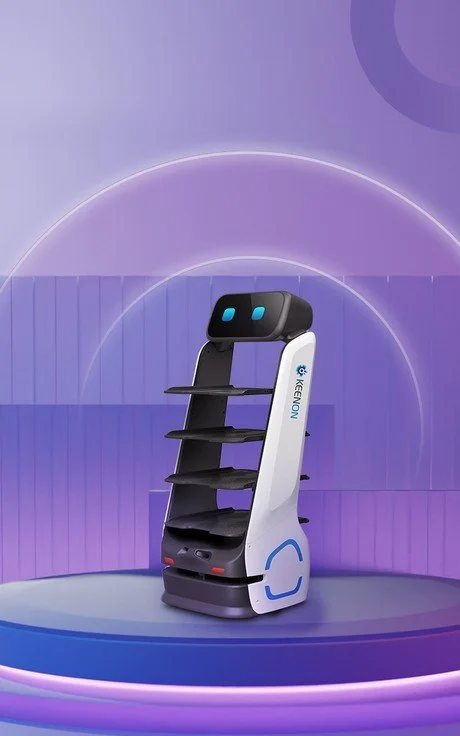
MarginSurge Score: 4.0 / 5
The T9 Pro is Keenon’s workhorse, and the one with the deployment numbers to back it up — Keenon states its DINERBOT T9 line runs in more than 25,000 restaurants and 10,000 hotels across 60+ countries, which, if accurate, makes it the single most widely deployed model on this list.
Payload: 88 lbs across four adjustable trays
Battery: up to 15 hours, 4-hour charge
Screen: 11.6" — smaller than the T10’s and noticeably smaller than the Dinnerbot B11’s
Financing: ProServBots lists explicit financing at roughly $378/month, one of the few hard monthly numbers we could actually verify across every reseller we checked
Where it loses points against the T10: less distinctive guest-facing design, smaller screen for upsell/advertising real estate, and no independent design award. It’s a safe, well-proven workhorse rather than the category leader.
Caddybot B2 (Bella) — Caddy Robotics
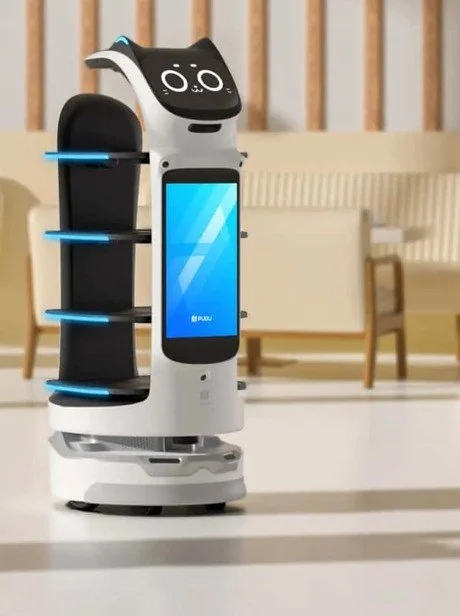
MarginSurge Score: 4.0 / 5
Worth knowing upfront: Caddybot B2 is Pudu’s original BellaBot hardware sold under Caddy Robotics’ own branding — the product page’s own copy refers to it as “BellaBot” throughout. What Caddy adds isn’t different hardware, it’s a restaurant-focused sales and financing layer.
Payload: 88 lbs across four trays
Battery: 12–24 hours depending on configuration — the longest runtime claim in this lineup, thanks to hot-swap battery capability
Navigation: dual LiDAR + visual SLAM
Financing: Caddy’s site promotes lease-to-own financing over 2–5 year terms and flags potential Section 179 tax deduction eligibility for U.S. small businesses — a genuinely useful angle for owner-operators, though we couldn’t independently verify their advertised “under $1,000/month” lease figure
Where it falls short: Caddy Robotics doesn’t publish list pricing — everything is quote-based — and as a newer reseller, there’s no public track record of restaurant case studies or third-party reviews to point to yet. The hardware is proven (it’s BellaBot); the reseller relationship is the unproven part.
Dinnerbot B11 — Caddy Robotics
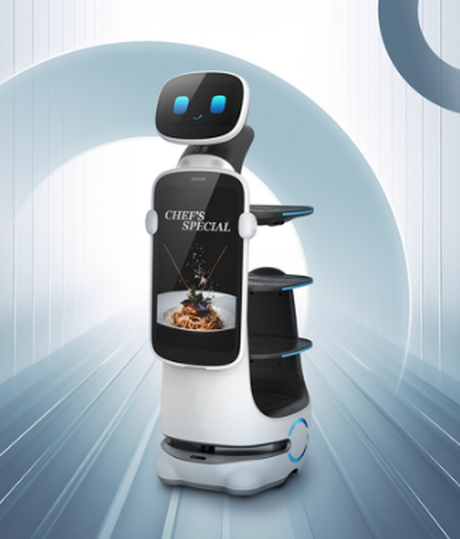
MarginSurge Score: 3.5 / 5
The B11 is built around guest-facing engagement — it carries the biggest single screen in this comparison (23.8", with a movable head) and the most cameras (5 stereo vision sensors plus 4 RGB cameras), which shows up in richer table-side interaction and sharper obstacle awareness.
Payload: 88 lbs across four trays
Battery: up to 8 hours — the shortest runtime of any robot on this list, and a real consideration for restaurants running double shifts without a convenient charging break
Charge time: 5.5 hours, also the slowest to top back up
Bottom line: great for guest experience and marketing display, but the battery math is the one spec here we’d push back on before recommending it for a high-volume, all-day operation. Better suited to lunch-and-dinner service with a natural midday lull than to nonstop counter-service environments.
Caddybot B5 Pro — Caddy Robotics
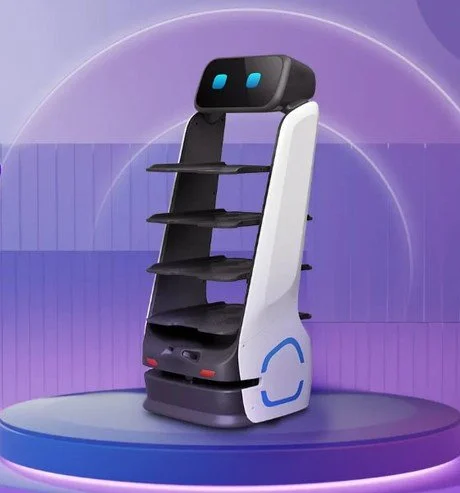
MarginSurge Score: 3.0 / 5
The B5 Pro is Caddy’s leaner, faster option — quicker top speed (up to 1.0 m/s) and a tighter footprint for narrower aisles — but it’s also the least differentiated robot in the lineup. Caddy’s product page doesn’t detail navigation tech or guest-interaction features the way it does for the B2, and there’s no model-specific financing information published beyond the general company FAQ.
Payload: 88 lbs across four adjustable trays
Battery: up to 18 hours
Best fit: tight-footprint dining rooms where maneuverability matters more than screen size or guest-facing personality
It’s a reasonable option if aisle width is your binding constraint, but for most full-service dining rooms, we’d point you toward the B2 or a Keenon model first.
How to Think About What These Cost
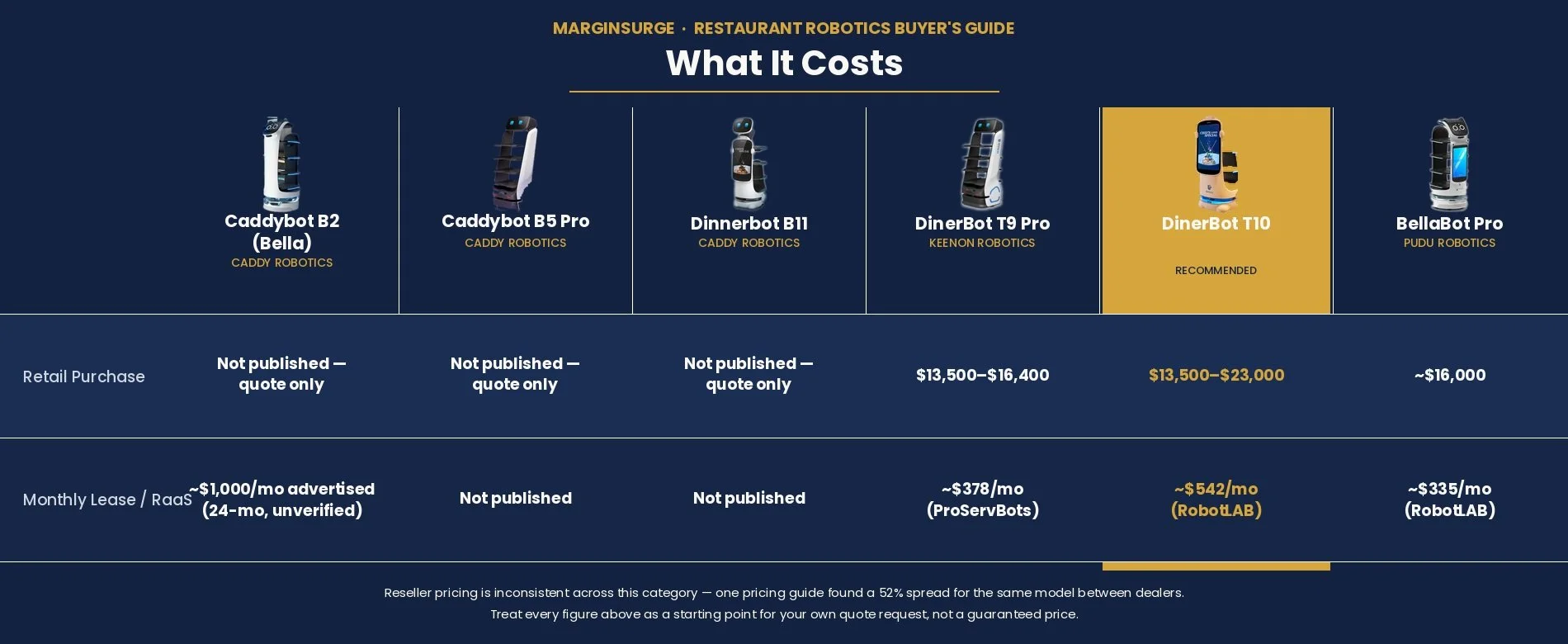
Pricing across this category is inconsistent — one pricing-guide analysis (GrabaRobot) found a 52% price spread for the same Keenon model across different dealers on the same day. Treat every number below as a starting point for negotiation, not a sticker price.
A few practical notes for owner-operators: leasing (sometimes marketed as “Robot-as-a-Service” or RaaS) typically bundles software updates, support, and sometimes maintenance into the monthly fee, which matters if you don’t have in-house tech staff. Buying outright usually pencils out cheaper over a 3+ year horizon, and equipment purchases can potentially qualify for Section 179 depreciation — ask your accountant, not your robot sales rep, to confirm eligibility for your specific business.
The ROI Case: Where the Savings Come From
Vendor case studies love to cite dramatic payback periods — some blogs cite paybacks as fast as 90 days, others 12–16 months — but those figures come from vendor-adjacent sources and case studies, not independently audited data, so we’d treat them as directional rather than a guarantee for your specific restaurant.
What’s more defensible is the labor math itself. With full-service labor running a median 36.5% of sales, even modest reductions in the labor hours spent on non-interpersonal tasks — walking food from kitchen to table, bussing dishes back — can matter. These robots aren’t replacing servers; they’re replacing the walking. A robot doesn’t need a table-side conversation to carry a tray of entrées 40 feet and back, and every trip it makes is a trip your server didn’t have to make, freeing them to greet the next table, take an order, or handle a guest issue instead.
The realistic ROI story for most restaurants isn’t “fire a server” — it’s redeploying the labor you already have toward the parts of service that actually require a human, while the robot absorbs the repetitive transport work in between.
What These Robots Actually Do on the Floor
Across every model in this comparison, the core task set is consistent:
Supporting staff: - Running food and drinks from the kitchen pass to the table - Bussing dirty dishes back to the dish pit - Carrying multiple orders per trip across several adjustable trays, reducing the number of kitchen-to-table walks per ticket
Supporting the guest experience: - Greeting and guiding guests to their table - Table-side interaction — birthday songs, animated expressions, voice responses to a touch or tap - On-screen advertising and upsell prompts (daily specials, drink pairings, loyalty promotions) displayed during transit, turning every delivery trip into a small marketing moment
That combination — logistics support plus a genuinely novel guest interaction — is why these robots have found traction even in restaurants that aren’t desperate for labor coverage. They’re as much a marketing and experience tool as they are a labor tool, and for many owners, the guest reaction (photos, social posts, kids requesting the “robot table”) ends up being as valuable as the labor hours saved.
Our Recommendation
For most full-service restaurants evaluating their first robot, we’d point you to the Keenon DinerBot T10 — it has the deployment scale, the independent design recognition, and the reseller network to back up a purchase you’ll be living with for years. If budget is the deciding factor and you want proven hardware with restaurant-specific financing support, the Caddybot B2 (Bella) is a reasonable second look, with the caveat that you’re buying into a newer reseller relationship rather than an established one.
Whichever direction you lean, get a written quote with the specific model, tray configuration, warranty terms, and financing structure spelled out before you sign — and if you want a second set of eyes on that quote, that’s exactly the kind of decision MarginSurge helps clients work through. A robot is one line in a bigger stack — the same break-even discipline applied to POS, ordering, labor automation and analytics is in our Complete Guide to Restaurant Technology & Automation in 2026.
MarginSurge provides restaurant operations consulting, including technology and automation planning for independent and multi-unit operators. Book a free call to talk through whether a service robot makes sense for your floor plan and labor model. We do this work hands-on for restaurants in Los Angeles and Phoenix.
Sources
National Restaurant Association, Restaurant labor costs are well above historical averages
KEENON Robotics’ DINERBOT T10 Wins the iF DESIGN AWARD 2025 — PR Newswire
Caddy Robotics product pages: Caddybot B2, Caddybot B5 Pro, Dinnerbot B11
RobotLAB: DinerBot T10, BellaBot Pro
Knoxlabs — Keenon DinerBot T9, ProServBots — Keenon DinerBot T9
Pudu Robotics, BellaBot Pro product page
This guide reflects publicly available manufacturer and reseller information as of August 2026. Specs, pricing, and financing terms change frequently in this category — always confirm current details directly with the vendor before purchasing.